Piercing Jewellery Sizes Explained: Gauge to mm Chart
Piercing Jewellery Sizes Explained: Gauge to mm Chart
Last updated 3 October 2026. Written by the Camden Body Jewellery team. How we check our jewellery.
This guide explains what the size numbers on piercing jewellery mean, so you can read any label with confidence. Our listings show gauge in both G and mm, plus the bar length or ring size, so you can match them to the chart below. Browse our titanium jewellery.
For pictures and help with a particular piercing, use our visual piercing jewellery size guide.
What do the three size numbers mean?
Every piece of piercing jewellery is described by its thickness, plus either its bar length or its ring size.
| Term | What it describes | Example label |
|---|---|---|
| Gauge or thickness | How thick the bar or ring is where it passes through the piercing. | 16G / 1.2mm |
| Bar length | The wearable post between the ends. It does not include the top, ball or back. | 6mm length |
| Inner diameter | The space across the inside of a ring. It does not count the metal. | 8mm inner diameter |
These examples explain the labels. They are not recommended sizes for any piercing.
Gauge to mm conversion chart
Gauge numbers work backwards. The smaller the number, the thicker the jewellery. So 14G is thicker than 16G, and 16G is thicker than 18G.
| Gauge | Thickness | How it compares |
|---|---|---|
| 22G | 0.6mm | Very fine |
| 20G | 0.8mm | Fine |
| 18G | 1.0mm | Fine to medium |
| 16G | 1.2mm | Medium. The most common thickness in our range |
| 14G | 1.6mm | Thick |
| 12G | 2.0mm | Very thick |
| 10G | 2.5mm | Very thick, usually stretched piercings |
| 8G | 3.0mm | Very thick, usually stretched piercings |
Gauge comes from an old wire measuring system. Body jewellery uses rounded millimetre figures, so 16G is sold as 1.2mm. Always check the mm figure on a listing as well as the gauge. Never force thicker jewellery into a piercing.
How to read a product size
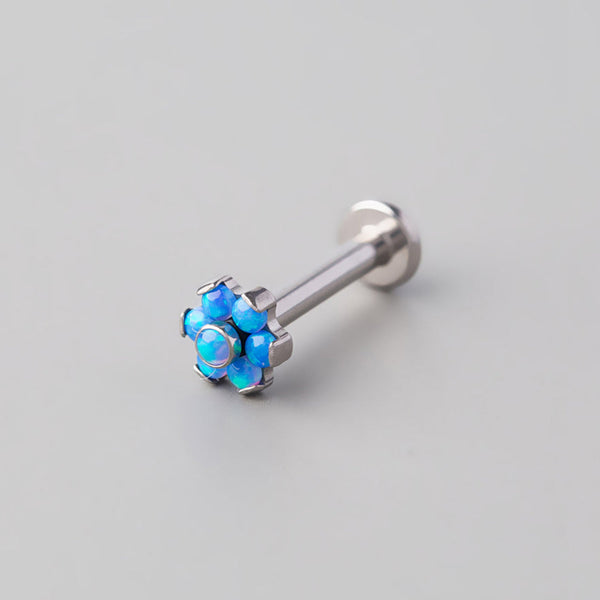
A labret labelled "16G / 1.2mm, 6mm length"
The post is 1.2mm thick and its wearable length is 6mm. The top and the flat back are not part of that length. The label does not mean it will fit every helix, tragus or lip piercing.
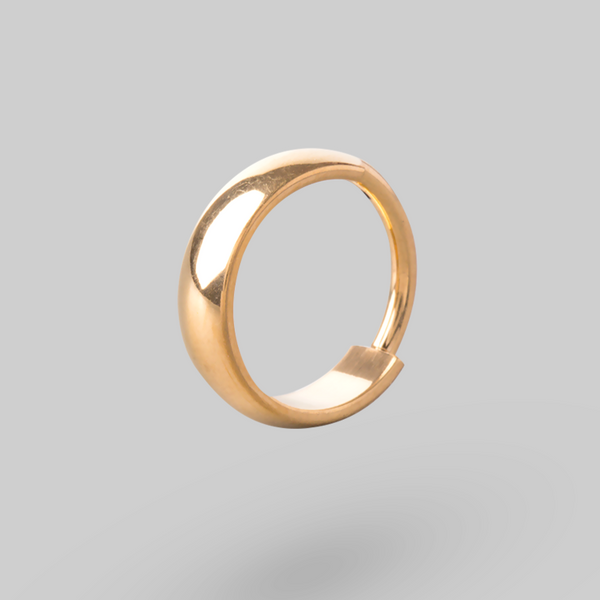
A ring labelled "16G / 1.2mm, 8mm diameter"
The metal is 1.2mm thick. If the listing says inner diameter, the space inside the ring is 8mm across. That is different from the ring's outside width.
A curved bar or shaped clicker
Check the product's measurement picture. The length along the bend is not the bar length. Oval and shaped clickers can have a different inside height and width, so one number may not describe the whole fit.
What is the difference between inner and outer diameter?
Inner diameter is the space inside a ring. Outer diameter is the full width, including the metal on both sides.
Body jewellery is sold by inner diameter, because that is the space your skin sits in. A 16G ring with an 8mm inner diameter is about 10.4mm wide on the outside, because the 1.2mm metal adds to both sides.
Does bar length include the ball or top?
No. Bar length is only the post between the two ends. The ball, gem, disc or back is measured separately.
The size of the top can still change how a piece feels. A big gem or disc sits further out and can catch on hair or clothes.
Why there is no one size for each piercing
Two people with conch piercings can need different ring sizes. Two helix piercings can need different post lengths. Where the hole sits, your anatomy and the shape of the jewellery all change the fit.
A size chart cannot pick a safe starter bar or tell you when to downsize. A piercer should check jewellery for a new or healing piercing. The Association of Professional Piercers explains why length and diameter must suit each person.
Find the sizes for your piercing
Each of our piercing guides explains the sizes most piercers use for that piercing.
- Ear: helix jewellery sizes, forward helix, flat, tragus, anti-tragus, conch jewellery sizes, rook, daith, snug and industrial bar sizes.
- Nose: septum jewellery sizes. For nostril and bridge, see the nose section of our visual guide.
- Lips and face: labret, lip, medusa, snake bites, smiley and eyebrow.
- Rings: circular barbell sizes.
- Body: see the belly section of our visual guide.
Check more than the size numbers
- Jewellery style: a straight post, a curved bar and a ring fit differently. One cannot always replace another.
- Connection: threaded and threadless ends attach differently. Matching the gauge alone does not mean a new top will fit.
- Top and back size: a gem or disc is measured separately from the bar, but its shape can still affect comfort.
- What is included: check whether you are buying a complete piece, a post on its own or a top on its own.
Learn more about threadless labrets and internal vs external threading.
Before you order
- Find your size from your piercer, your fitting record or a clearly labelled piece that fits.
- Compare those numbers with the product options. Do not assume the first option is your size.
- Check the shape, the connection and the top.
- Buying a gift? Check the size printed on a piece they already wear.
- If you are not sure, ask a piercer to check the fit.
Need to measure jewellery you already have? Follow the pictures in our visual measuring guide. Do not take out healing jewellery just to measure it.
Piercing jewellery sizes FAQ
Is 16G bigger than 18G?
Yes. 16G is about 1.2mm thick and 18G is about 1.0mm. Gauge only describes thickness, not length.
Is 1.2mm the same as 16G?
Yes. In body jewellery, 16G and 1.2mm mean the same thickness. Many UK shops show both.
What is 14G in mm?
14G is 1.6mm. It is thicker than 16G (1.2mm).
What gauge is a normal earring?
Most fashion earrings have a post of about 20G (0.8mm) or thinner. Piercing jewellery is often thicker, so always check the mm figure.
Does "8mm" mean thickness or ring size?
It depends on the label. 8mm can mean bar length or inner diameter. A number without its measurement type is not enough to choose a piece.
Does bar length include the ball?
No. Bar length is only the post between the ends. The ball, gem or back is measured separately.
What is the difference between inner and outer diameter?
Inner diameter is the space inside a ring. Outer diameter includes the metal on both sides. Body jewellery is sold by inner diameter.
Can I use my stud length to choose a hoop?
No. Post length and ring size describe different shapes. Check the ring size on its own.
Are UK and US size labels the same?
Both use the same gauge numbers. Rounding can differ a little between brands, so compare the mm figure.
What if a ring will not close?
Do not force it closed in your piercing. The size or the closure may need checking. Ask your piercer, or contact us about the product.
Key takeaways
- Gauge is thickness, bar length is the post between the ends, and inner diameter is the space inside a ring.
- Gauge works backwards: 14G (1.6mm) is thicker than 16G (1.2mm), which is thicker than 18G (1.0mm).
- Bar length never includes the ball, gem or back.
- Rings are sold by inner diameter, not outside width.
- Check the mm figure, the style and the connection, not just the gauge.
- For the sizes used for your piercing, read its own guide or ask your piercer.
Shop by size
Our listings show every size option in G and mm, and everything is implant grade titanium (ASTM F136). Once you know your numbers, compare the options on our threadless labret (20G to 14G, 6 to 10mm bars, £14), segment ring (20G to 14G, 5 to 12mm, £15) or seamless nose hoop (20G or 18G, 6 to 10mm, £14).
Questions about a listing's measurements? Send us a message and we will explain exactly what you are getting. For fit, your piercer is the best person to check.
Read next
- Visual piercing jewellery size guide
- Threadless labrets: how they work
- Internally vs externally threaded jewellery
- The guide to circular barbells
Sources: Association of Professional Piercers, Jewelry for Initial Piercings
Stop The Reaction Before It Starts
90% of piercing irritation comes from poor quality metal. Upgrade to ASTM F-136 Implant Grade Titanium-the biocompatible gold standard used by professional piercers worldwide.
Myths vs. Reality
Myth: "Itchiness means infection."
False. Infection usually involves throbbing pain, heat, extreme swelling, and yellow/green pus. Mild itching alone is rarely an infection.
Myth: "Turn the jewelry to scratch the itch."
Never twist! Twisting breaks the healing seal, introduces bacteria inside the wound, and extends healing time by weeks.
Why Shop CBJ?
-

Implant Grade Titanium
ASTM F-136 Compliant
-

Tracked UK Delivery
Free over £40
-

Sterilised Piercing Jewellery
Keeping your skin safe