Dermal Piercing: Complete Guide to Pain, Healing, Jewellery & Aftercare (2026)
Quick answer: A dermal piercing (also called a microdermal or skin diver) is a single-point surface piercing anchored under the skin with a small titanium foot plate. It takes around 1 to 3 months to surface heal and up to 6 months to fully settle, with a higher rejection rate than traditional piercings. Aftercare is simple but strict: twice-daily saline soaks, no picking at the crust, and never rotate or twist the top.
Dermal piercings have become one of the most requested modifications in UK studios, and for good reason. They can be placed almost anywhere flat on the body, they give a gemstone-set-into-the-skin look that no other piercing can replicate, and the jewellery itself is discreet and interchangeable. But they are also the single most misunderstood piercing we deal with at Camden Body Jewellery.
This guide walks through everything you need to know before booking, during healing, and for the long-term life of your dermal. It is written for a UK audience and reflects how we fit, stock, and advise on anchors, tops, and aftercare every day.
What Is a Dermal Piercing?
A dermal piercing is a single-point piercing, meaning it has an entry but no exit. Unlike a standard piercing that passes straight through tissue (like a helix or a nostril), a dermal sits vertically in the skin: a small anchor is embedded below the surface and a decorative top screws onto a threaded post that sits flush with the skin.
The anchor has a perforated foot plate, usually made from ASTM F136 implant grade titanium. Over the healing period, tissue grows through the holes in the plate, locking the anchor firmly into place. This is why a properly healed dermal can feel as secure as a surface tattoo, and why you should never try to pull one out at home.
People sometimes confuse dermals with skin divers. A skin diver is a simpler, single-piece version with a non-removable decorative stone and a pointed base instead of a foot plate. Skin divers are quicker to fit but usually reject faster and offer no ability to change the top. For most clients we recommend a traditional anchor-and-top system.
Where Can You Get a Dermal Piercing?
In theory, almost any flat area of skin with enough subcutaneous tissue will take a dermal. In practice, some placements heal far better than others. Popular and reasonably reliable sites include:
- Chest (sternum or upper chest): one of the most requested placements and a generally good healer.
- Nape of the neck: striking but prone to snagging on collars, scarves, and hair.
- Lower back or hip dimple: good anatomy in most people, but waistbands are the enemy.
- Cheekbone or temple: high-impact look, but extremely high rejection risk and not recommended by most reputable UK piercers.
- Finger, wrist, or ankle: very high rejection rate due to constant movement and friction; best avoided.
A reputable piercer will always assess your anatomy before agreeing to a placement. If someone is willing to dermal anywhere you point, that is a red flag, not a green light.
How Much Does a Dermal Piercing Hurt?
Most people rate the initial piercing between 4 and 6 out of 10. It is a sharper, more pressured sensation than a standard cartilage or lobe piercing because a small dermal punch is used to remove a tiny core of tissue before the anchor is inserted. The sharpest moment is very brief, but the pressure as the anchor is seated can feel unusual.
Pain varies significantly with placement. Thinly fleshed areas over bone (sternum, collarbone, cheek) feel sharper. Areas with more give (upper arm, hip) feel duller and more bruise-like.
Dermal Piercing Pain Compared to Other Piercings
| Piercing | Typical Pain (out of 10) | Sensation |
|---|---|---|
| Earlobe | 2 to 3 | Quick sting |
| Nostril | 3 to 5 | Sharp, eyes water |
| Helix | 4 to 6 | Crunching pressure |
| Dermal (chest, arm) | 4 to 6 | Sharp pinch, firm pressure |
| Industrial bar | 6 to 8 | Two piercings back-to-back |
| Nipple | 6 to 8 | Intense, short-lived |
How Long Does a Dermal Piercing Take to Heal?
Healing happens in two stages with a dermal. The surface healing is when the entry point closes over and stops weeping. Full internal healing is when the tissue has grown through the foot plate and the anchor is properly locked in. Both matter.
| Stage | Timeframe | What to Expect |
|---|---|---|
| Acute phase | 0 to 2 weeks | Tenderness, redness, light bleeding, clear lymph fluid, and crusting around the top. |
| Surface healing | 1 to 3 months | Crusting reduces, skin closes around the post, top feels stable when touched. |
| Consolidation | 3 to 6 months | Tissue grows into the foot plate. Avoid knocks and snags. |
| Fully settled | 6 to 9 months | Safe for your piercer to change the top. Anchor feels fixed and painless. |
These timeframes are guidelines. Smokers, anyone on immunosuppressants, and people with autoimmune conditions like psoriasis or eczema at the site can expect the upper end or slower. Placement matters too: a chest dermal protected by loose clothing will heal faster than a hip dermal sitting under a jeans waistband.
Dermal Piercing Jewellery: What Goes Where
A dermal piercing uses a two-part system. Understanding each part helps you choose the right tops and avoid common irritation problems.
1. The Anchor (Foot)
This is the piece embedded under your skin. It is a small L-shaped or T-shaped plate with holes, topped with an internally threaded post. A quality anchor should be:
- Implant grade titanium (ASTM F136): the gold standard for new dermals. Biocompatible, nickel-free, and safe for sensitive skin.
- Internally threaded: the post threads receive a screw from the top, so nothing rough passes through the healing fistula.
- Correct rise height: thicker skin needs a taller post so the top sits flush without sinking.
2. The Top (Decorative End)
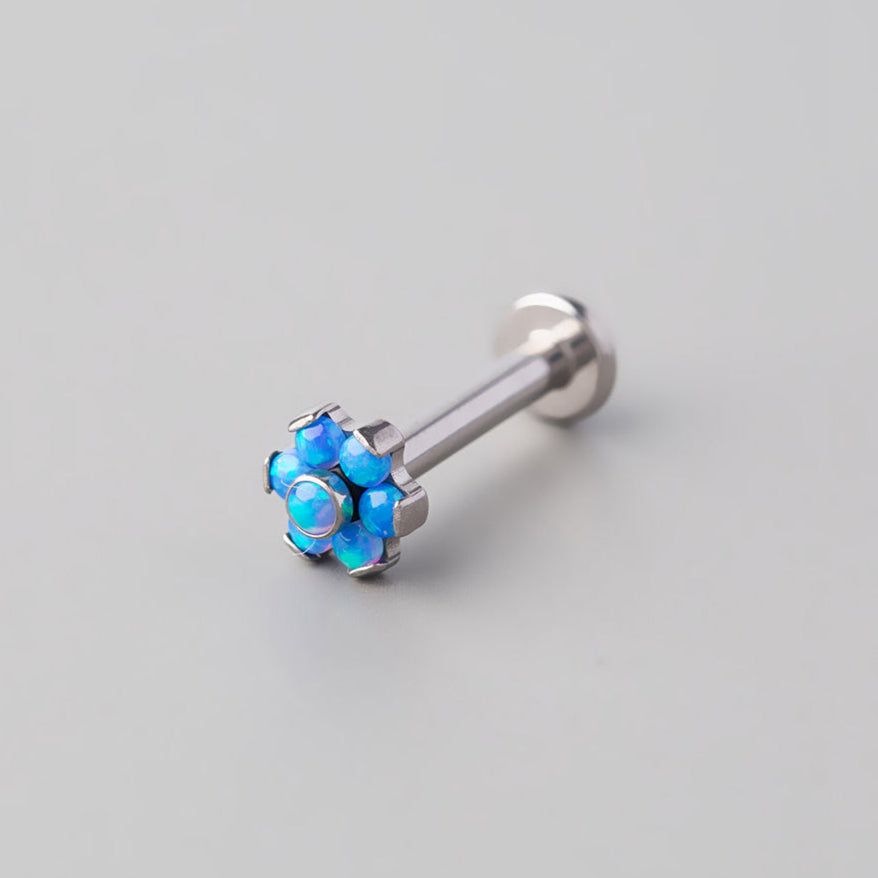
This is the only part you see. Tops screw onto the anchor post and come in countless styles: flat discs, gemstones, opals, spikes, clusters, and shapes. Because tops are interchangeable, one anchor can support years of different looks.
Material Comparison for Dermal Tops
| Material | Healing Suitability | Best For |
|---|---|---|
| Implant grade titanium (ASTM F136) | Excellent, from day one | Initial piercings and sensitive skin |
| Solid 14k or 18k gold | Excellent once healed | Long-term wear, premium finish |
| Surgical steel (316L/316LVM) | Good for healed piercings | Budget-friendly tops post-healing |
| Gold-plated or plated alloys | Not recommended during healing | Occasional wear only |
| Acrylic | Never in a fresh dermal | Avoid entirely for dermals |
We only stock implant grade titanium and solid gold for fresh dermal fittings at Camden Body Jewellery, because anything less is a false economy on a piercing this sensitive to irritation.
Dermal Piercing Aftercare: A Step-by-Step Routine
Aftercare for dermals is actually simpler than most piercings, because you should not be moving or rotating the jewellery at all. The two rules are: keep it clean, and leave it alone.
- Wash your hands with plain soap and dry them with a clean paper towel before doing anything near the piercing.
- Saline soak twice a day. Soak a clean cotton pad or sterile gauze in sterile saline solution (0.9% sodium chloride) and hold it gently over the piercing for 3 to 5 minutes. This softens crust and draws out lymph.
- Rinse, do not scrub. After soaking, lightly rinse any remaining crust off. Never pick at the top or anchor.
- Pat dry with a disposable paper towel. Bath towels harbour bacteria and can snag the top.
- Protect it. Cover with a breathable plaster for sports, sleep, or tight clothing contact for the first few weeks if your piercer recommends it.
- Leave the top in place. Do not swap tops, tighten them, or wiggle them for at least the full surface healing window. Any top change should be done by a piercer.
For a full aftercare breakdown that applies across all piercings, see our complete body jewellery and piercing aftercare guide.
Things That Ruin a Dermal Fastest
- Rotating, twisting, or playing with the top, which tears tissue inside the channel.
- Sleeping directly on the piercing for the first 3 months.
- Submerging in pools, hot tubs, lakes, or the sea before surface healing.
- Using harsh antiseptics (alcohol, hydrogen peroxide, tea tree oil neat) which kill healing cells along with bacteria.
- Wearing tight waistbands, bra straps, or collars that constantly rub across the top.
- Catching the top on clothing, towels, or hair brushes. A single big snag can migrate a dermal overnight.
Rejection, Migration, and When to See a Piercer
Dermals have a higher rejection rate than traditional piercings because the body is constantly trying to push out any foreign object it cannot fully enclose. Rejection is not a failure on your part, but there are early signs worth watching for:
- The top appears to be sitting higher than it used to, or tilts to one side.
- The skin over the anchor becomes thin, shiny, or translucent.
- You can see the outline of the foot plate through the skin.
- Persistent redness, pain, or discharge beyond the first few weeks.
If you notice any of these, book an appointment with your piercer rather than waiting. A dermal that is migrating can sometimes be saved if caught early, but a rejecting dermal needs to be professionally removed before it comes out in a way that scars badly.
If you are worried about a lump near the piercing, our guide on piercing bumps, keloids, and infections explains how to tell normal healing from a problem.
Can You Remove a Dermal Piercing Yourself?
No. A properly healed dermal has tissue grown through the foot plate, and attempting a home removal can cause significant scarring, bleeding, and a permanently dimpled site. Reputable UK piercers will remove a dermal in a sterile setting, usually with a small incision to free the anchor cleanly. This takes minutes and heals within a couple of weeks.
Changing Your Dermal Top
The beauty of a dermal is that the top can be swapped. Because the post is internally threaded, a new top simply screws on. Rules of thumb:
- Wait at least 6 months before the first top change, and only let your piercer do it.
- Once fully settled, tops can be swapped at home with clean hands, but many clients still prefer to have it done at a studio.
- Always stick to implant grade titanium or solid gold for anything you wear long term.
- Never force a top. If it does not unscrew easily, stop and see a piercer.
Browse our full range of threaded dermal tops in titanium and gold for once you are ready to change up the look.
Dermal Piercing vs Surface Piercing vs Skin Diver
| Feature | Dermal (Anchor) | Surface Piercing (Bar) | Skin Diver |
|---|---|---|---|
| Number of holes | One (single-point) | Two | One |
| Jewellery type | Foot-plate anchor + threaded top | Flexible surface bar | Single-piece pointed base |
| Top changeable? | Yes | Yes (both ends) | No |
| Average lifespan | 1 to 5+ years | 6 months to 2 years | 6 to 18 months |
| Rejection risk | Moderate | High | High |
Key Takeaways
- A dermal piercing is a single-point piercing anchored by a foot plate beneath the skin.
- Surface healing takes 1 to 3 months; full consolidation around the anchor takes 6 to 9 months.
- Implant grade ASTM F136 titanium is the safest material for both the anchor and the initial top.
- Saline soaks twice daily and no touching is the entire aftercare routine.
- Rejection rates are higher than traditional piercings, especially on fingers, wrists, and faces.
- Removal, top changes, and anything that unscrews should be handled by a qualified piercer, particularly in the first 6 months.
Shop the Right Jewellery
At Camden Body Jewellery we stock a wide range of ASTM F136 implant grade titanium dermal anchors and interchangeable tops, along with solid gold options for once your piercing has settled. Every piece is shipped in sealed sterile packaging.
- Browse our dermal tops collection for interchangeable titanium and gold designs.
- Explore our full implant grade titanium body jewellery range for other healing-safe options.
Frequently Asked Questions
Can I shower with a new dermal piercing?
Yes. You can shower the same day you get it pierced. Let plain warm water run over the area, avoid getting shampoo or shower gel directly on it, and pat dry gently with a paper towel afterwards. Skip baths, hot tubs, and swimming pools until surface healing is complete.
How long before I can swim with a dermal?
Wait until the surface is fully healed, which is usually 2 to 3 months. Chlorinated pools, hot tubs, and open water all carry bacteria that can enter the channel around the post and trigger infection or rejection.
Why is my dermal crusty?
Clear or pale yellow crust is dried lymph fluid, and it is a completely normal sign that healing is underway. Soften it with a saline soak and rinse gently. Never pick at it with your fingers or a cotton bud, as this pulls the healing tissue with it.
My dermal top fell off. What should I do?
Do not panic. The anchor is likely still in place with an empty threaded post. Keep the site clean and cover with a plaster, then contact your piercer to fit a replacement top as soon as possible, especially in the first year. Once the post is exposed, dust and bacteria can get into the threads.
Can I wear makeup over a dermal?
Avoid any makeup, moisturiser, fake tan, sunscreen, or perfume directly over the piercing for the full surface healing period. Products clog the channel and irritate the healing tissue. Once fully healed, keep products off the top itself to avoid dulling gemstones or plating.
Will a dermal leave a scar when removed?
Usually a small round scar or dimple remains, similar in appearance to a chickenpox mark. The final appearance depends on your skin type, how long the dermal was in, whether it rejected or was removed cleanly, and your aftercare post-removal.
How often can I change the top?
Once healed, as often as you like, although every change is a small trauma to the site. Most clients settle on one or two favourite tops and swap occasionally. Always use clean hands and implant grade or solid gold tops.
Are dermals safe if I have sensitive skin or a nickel allergy?
Yes, provided you stick strictly to ASTM F136 implant grade titanium or solid 14k/18k gold. Avoid plated, alloy, or surgical steel anchors if you have a confirmed nickel sensitivity, and read our guide on implant grade titanium vs steel body jewellery before choosing.
Can I get an MRI scan with a dermal?
Implant grade titanium anchors are generally considered MRI-safe, but always tell the radiographer you have a dermal and show them the placement. They will advise whether removal or monitoring is needed based on the type of scan.
What if my dermal is rejecting?
See a professional piercer as soon as you suspect rejection. Signs include the top sitting higher, thinning or shiny skin over the anchor, and persistent soreness. Letting a rejecting dermal work its own way out almost always leaves worse scarring than professional removal.
Read Next
Stop The Reaction Before It Starts
90% of piercing irritation comes from poor quality metal. Upgrade to ASTM F-136 Implant Grade Titanium-the biocompatible gold standard used by professional piercers worldwide.
Myths vs. Reality
Myth: "Itchiness means infection."
False. Infection usually involves throbbing pain, heat, extreme swelling, and yellow/green pus. Mild itching alone is rarely an infection.
Myth: "Turn the jewelry to scratch the itch."
Never twist! Twisting breaks the healing seal, introduces bacteria inside the wound, and extends healing time by weeks.
Why Shop Camden?
-

Implant Grade Titanium
ASTM F-136 Compliant
-

Tracked UK Delivery
Free over £40
-

Sterilised Piercing Jewellery
Keeping your skin safe